

Inside the Scam-demic: Fraud and Ontario Real Estate
On September 16th I sat in on a fraud prevention seminar led by Detective John Armit, a 24-year veteran of the Ontario Provincial Police who now works as a cyber-enabled fraud and anti-fraud detective in the OPP's Financial Crimes Unit. Detective Armit has received an award of excellence through FINTRAC, the Financial Transactions and Reports Analysis Centre of Canada. Many of you will recognize FINTRAC from our own transactions together. It's the reason I ask for your ID during a deal. I'm required to file a FINTRAC report on large value transactions, part of a national effort to track down financial crime and terrorism financing.
What I heard in that session was eye opening, and given how much of it connects directly to real estate, I wanted to share it with you.
The Numbers Are Climbing Fast
According to the Canadian Anti-Fraud Centre, reported fraud losses in Canada have grown every year:
As of December 31, 2023: $577 million in reported losses
As of December 31, 2024: $648 million in reported losses
As of December 31, 2025: $704 million in reported losses
And here's the part that should really give you pause. The Canadian Anti-Fraud Centre (CAFC) estimates that only 5 to 10 percent of fraud victims actually report what happened to them. The real number being stolen from Canadians every year is likely many multiples higher than what shows up in the official statistics.
Locally, the OPP has broken things down by region. In Eastern Ontario alone, from January through September of this year (2026), there was $9.3 million in reported fraud across 620 incidents. In the Western region, losses topped $30 million. This isn't happening somewhere else. It's happening right here.
Where the Money Is Actually Going
Looking at CAFC's 2025 breakdown by dollar loss, investment fraud sits far above everything else at $351 million, followed by spear phishing at $67.9 million, romance and relationship fraud at $63.3 million, job scams at $50.6 million, fake fraud investigators at $28.3 million, recovery pitch scams at $25.9 million, extortion at $23 million, service fraud at $19.5 million, merchandise scams at $11.7 million, and prize scams at $5.7 million.
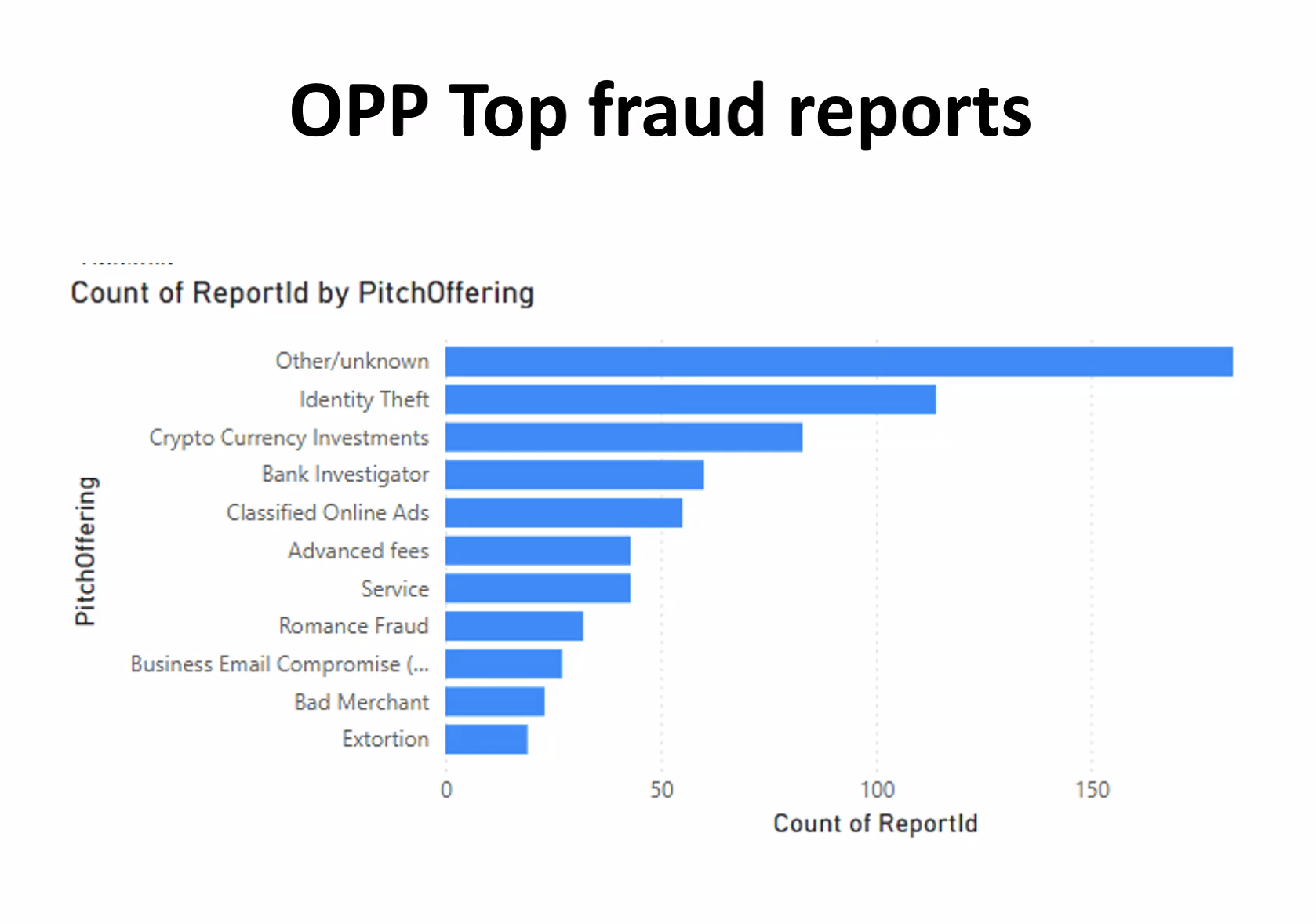
By number of reports, identity fraud leads with over 8,400 reports, followed closely by investment scams, service fraud, and personal information theft.
Your Driver's Licence Is the Prime Target
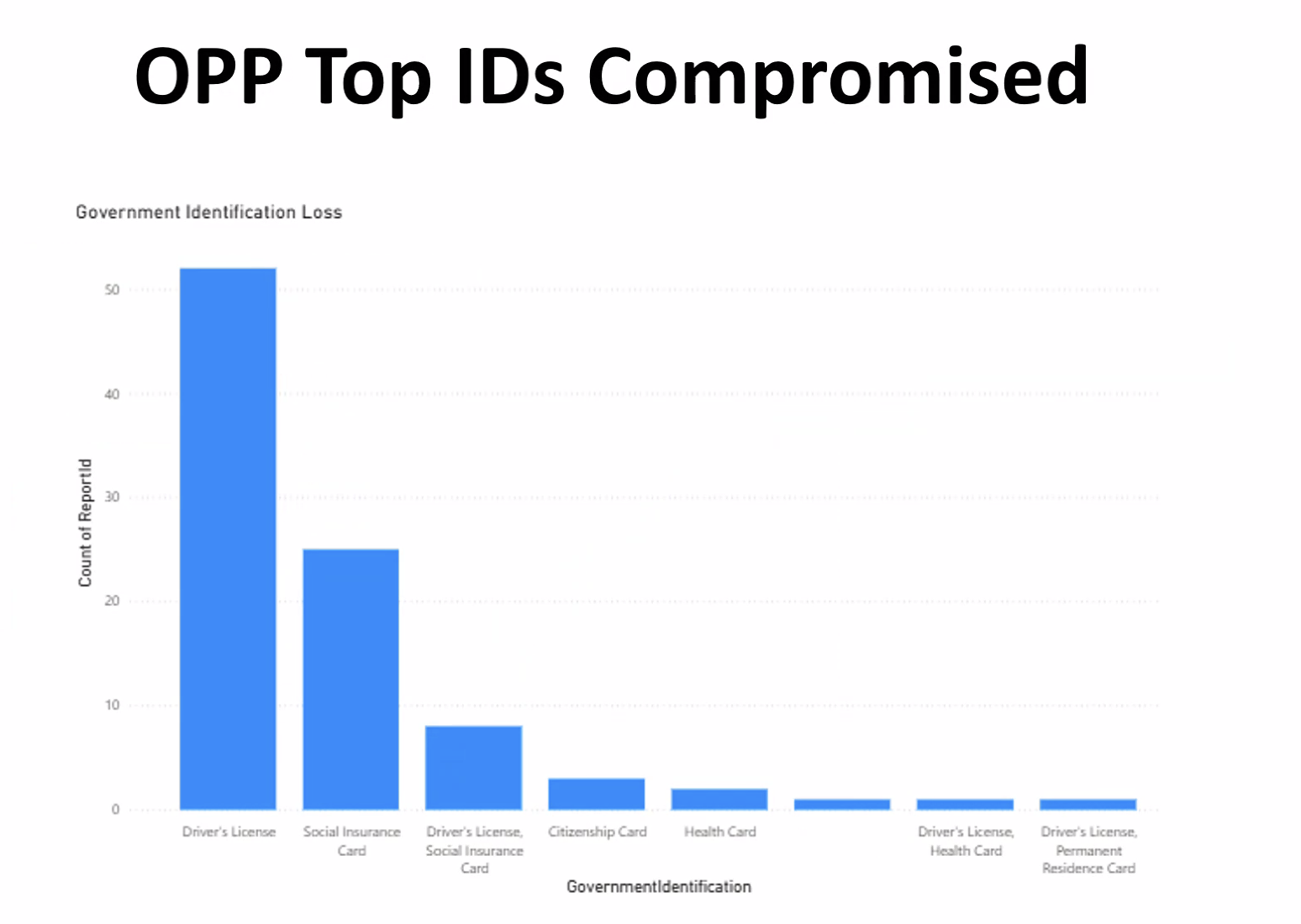
Detective Armit walked through OPP data on which pieces of identification are most often compromised. Driver's licences top the list by a wide margin, followed by Social Insurance cards. He explained that fraudsters can purchase blank card stock and replicate a driver's licence with surprising ease, or simply buy one on the dark web complete with the correct holograms. Visually, there's often no way to tell the difference. His view is that Canada needs stronger identity verification standards than a driver's licence and a SIN card, because the current system is being exploited constantly.
Fraud has also become a packaged product. On the dark web, criminals can purchase what's essentially a business starter kit for running scams, tools, templates, and stolen data included.
Recent headlines back this up. Just this year we've seen an RBC employee in Ottawa charged with fraud and identity theft in an alleged scheme tied to a high profile bank customer, a Toronto law firm at the centre of a $7 million embezzlement that went undetected for years, a Calgary realtor banned for life after a $3.5 million fraud involving bogus real estate deals, and a Saskatchewan town and rural municipality conned out of nearly $700,000 through a sophisticated scheme. The Canadian Anti-Fraud Centre has also flagged a surge in "pig butchering" crypto and romance scams making their way through Ontario. Pig Butchering is fattening up the victim before the slaughter - like in a romance scam they work them for months before asking for something.
Service Fraud Hits Close to Home
A lot of the fraud we all encounter weekly, sometimes daily, falls under the "service fraud" category. Some of the tactics Detective Armit described:
Spoofed search ads. Scammers pay to have a fake company appear near the top of Google search results. You search for an insurance company or another service that requires your identification, apply through what looks like a legitimate site, and hand your information straight to a criminal.
Fake cell towers for SMS phishing. A recent case in Toronto involved a Chinese organized crime group operating a portable fake cell tower. Anyone who came within its range received a phishing text SEE THE FULL VIDEO HERE
Spear phishing. Some organized groups pose as an IT provider or a service you've recently used and send an email that looks completely legitimate, sometimes appearing to come from your own employer or head office. Click the link, and malware gets installed on your device. From there, criminals can monitor your activity for months, study your documents, and eventually replicate an invoice or contract to trick you into sending money for something that never existed.
Door to door contract scams. This one shows up in real estate more than people realize. Salespeople, often targeting seniors, lock homeowners into long term furnace and air conditioning rental contracts. I've personally seen this while preparing homes for sale, a furnace or AC unit installed only a year or two ago under a rental agreement with a buyout of $15,000, roughly double the cost of buying the unit outright. In some cases these contracts get sold off to debt collectors, who then pursue homeowners, or their estates, for the balance.
Two men were recently arrested and three more are wanted in connection with a door to door sales fraud that victimized over 200 Ontarians. Ontario has since introduced legislation aimed at strengthening protections for homeowners and homebuyers.
Romance Fraud and Forced Scam Compounds
One of the more disturbing parts of the seminar covered fraud operations run out of large compounds in Southeast Asia. People are lured in with promises of legitimate jobs, then held in what are essentially forced labour camps (including torture and abuse) where their only task is running scams around the clock, day after day. This photo shows what was recently rice fields in Cambodia turned into scam-town courtesy of Chinese fraud organizations.
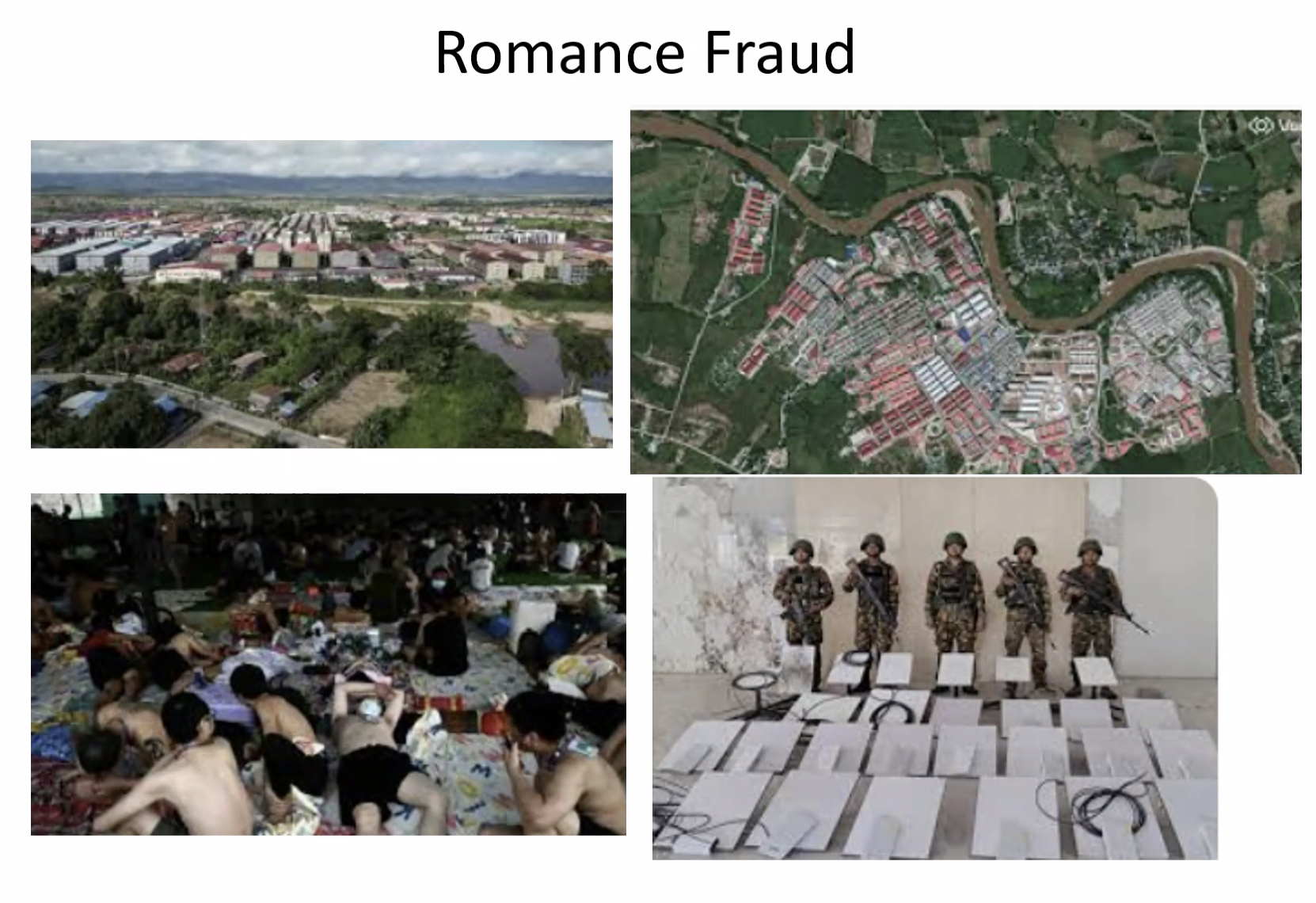
A common script for romance scams targets seniors who've lost a spouse. A scammer builds a relationship over months, sometimes claiming to be a soldier stationed overseas, expressing love and eventually asking for money toward a shared future, a house, a retirement plan that will never materialize. The image above shows Starlink to stay connected from remote locations, and there's active pressure internationally to restrict that access in known scam compound regions. Law enforcement across borders is struggling to track and shut these operations down.
Following the Money Is Nearly Impossible
Once wire fraud is reported, there's roughly a two year backlog just to trace the transfer. By the time investigators catch up, the money has often already moved through cryptocurrency and been funnelled through a shell company. Setting one up can cost as little as a couple hundred dollars and a name. Criminals will also chain scams together, using proceeds from one fraud to fund a fabricated story in a romance scam, then have that second victim convert funds to Bitcoin and send them off again. By the time anyone traces it, the trail runs cold.
Emergency and Grandparent Scams
These scams involve a call or text claiming a family member has been in an accident and needs money urgently, often to be "admitted" to a hospital. My own grandmother once received a call from someone claiming to be a hospital worker, saying I'd been in a serious accident and that $2,500 was needed immediately for an ambulance admission. She called me in a panic. I was fine and driving in my car at the time. A major OPP investigation in 2022 dismantled a network responsible for these calls across the country, but the wiretap operation alone cost roughly $2 million to run.
When Fraud Crosses Borders
Detective Armit shared a case involving a man, Mohamad, who entered Canada using a forged Scandinavian passport, easily made his way into Montreal, then reportedly crossed into the United States by jet ski before travelling to Los Angeles. Mohamad spent roughly two years there running fraud schemes that cost Canadian and American victims hundreds of thousands of dollars before he was finally caught.
Even large companies aren't immune. Rogers had internal employees implicated in scams against the company itself. As Detective Armit put it, this is a full blown "scamdemic," and AI is only making it easier to pull off convincing scams at scale.
What This Means If You're Buying or Selling
Real estate is an active target. Fraudsters reach out to realtors through platforms like realtor.ca claiming to want to buy a home, ask to connect over Zoom, then send a link that installs malware once clicked. This malware can reveal a lot of your personal information. There are also cases of overseas buyers submitting falsified documents to try to purchase property outright. The stakes are high. If a transaction closes and it's only afterward discovered that the buyer wasn't who they claimed to be, there's often very little recourse. What if you already bought a home legitimately and you find out your buyer was busted for fraud?
Or what about Moiz Kunwar in Brampton, who took real estate deposits from at least nine homebuyers in the GTA for pre-construction houses he didn't have the right to sell and which were being built by unrelated, legitimate developers. This cost the victims hundreds of thousands of dollars.
Title fraud – this occurs when a fraudster steals the identity of a homeowner and sells or refinances the property without the owner’s knowledge.
Mortgage fraud – fraudsters may falsify information on a mortgage application to obtain a loan that they have no intention of paying back.
Rental fraud – scammers may advertise a rental property that does not exist, take deposits from multiple victims, and disappear with the money.
Investment fraud – fraudsters may claim to have a great investment opportunity in real estate and ask for upfront fees or investments, but the opportunity is either nonexistent or has little chance of success.
Foreclosure fraud – this occurs when a homeowner facing foreclosure is promised help by a fraudster who takes their money and does not provide any assistance.
Deposit fraud - This is when the Broker of Record of a low-budget real estate firm uses the trust account, where your deposit for purchase is held, as his/her own personal piggy-bank.
The scammers are active and they’re out to get us. They’re adapting, getting smarter, and taking bigger risks. That's exactly why working with someone who verifies identity properly, watches for red flags, picks up the phone and asks questions (lots of them), and stays current on how these schemes evolve matters at every stage of a deal. A full team of services who all work together. I say it religiously, realtor, lender, lawyer, all working together on your behalf.
A Few Ways to Protect Yourself
Do your research – always research the property and the seller before making any purchases or signing any contracts. Check the ownership records, title history and any liens or encumbrances on the property. The Parcel Abstract will tell us more than the seller may actually know.
Verify information – verify any information provided by the seller, buyer, or realtor, such as their identity, contact information, and employment status. I always ask about their client over the phone and I can tell within seconds how well they know their client.
Do not wire money – avoid wiring money to anyone you do not know, especially if it is for a rental or investment opportunity.
Use a trusted lawyer – always use a trusted lawyer to handle your real estate transactions. The lawyer will help identify any potential issues and ensure that all legal requirements are met.
Use a trusted lender - absolutely crucial to ensure your financing is legit. An uneducated lender may unknowingly be part of a scam.
Deposit Protection - Watch out for brokerages with names like Save Max, True Save, Best Deal, Minmaxx, names that sound discount. Especially in Mississauga, Brampton, and now Hamilton. Let’s keep your hard-earned deposit in my company’s trust account, ReMax.
Be cautious of unsolicited offers – be wary of unsolicited offers, especially if they are too good to be true. If it sounds too good to be true, it probably is.
Place a credit freeze with Equifax and TransUnion if you suspect anything is off. This stops new credit from being opened in your name.
Trust your gut. If a call, text, or email feels off, it probably is.
Never click urgent links. If someone says you need to act immediately, close the message and call me and/or our lawyer.
Verify before you trust. Whether it's a buyer reaching out online or a contractor at your door, take the time to check who you're actually dealing with.
Hire a full-time Realtor. Someone with experience who lives and breathes real estate. If they don’t, who knows..
The Canadian Anti-Fraud Centre keeps an extensive, up to date list of scam types, from money mules and spear phishing to landlord and tenant rent scams, fake low interest rate offers, and tax related fraud. You can explore it here: https://antifraudcentre-centreantifraude.ca/index-eng.htm
Fraud is evolving quickly, and staying informed is one of the best defences we have. It's also part of why I stay plugged into what's happening so that when you're buying, selling, or just have a question about something that doesn't feel right, you have someone in your corner who's paying attention.
If anything here raises a flag for you or someone you know, don't be scared to click that link!
Stay safe,
Andrew
