

Ontario Rental Rules Change on September 21, 2026: What Landlords and Tenants Need to Know
On September 21, 2026, a second group of amendments to Ontario's Residential Tenancies Act (RTA) takes effect. The RTA is the provincial law that governs most residential rentals, and the Landlord and Tenant Board (LTB) is the tribunal that resolves disputes under it. The amendments come from two pieces of legislation: Bill 60, the Fighting Delays, Building Faster Act, 2025, and Bill 97, the Helping Homebuyers, Protecting Tenants Act, 2023.
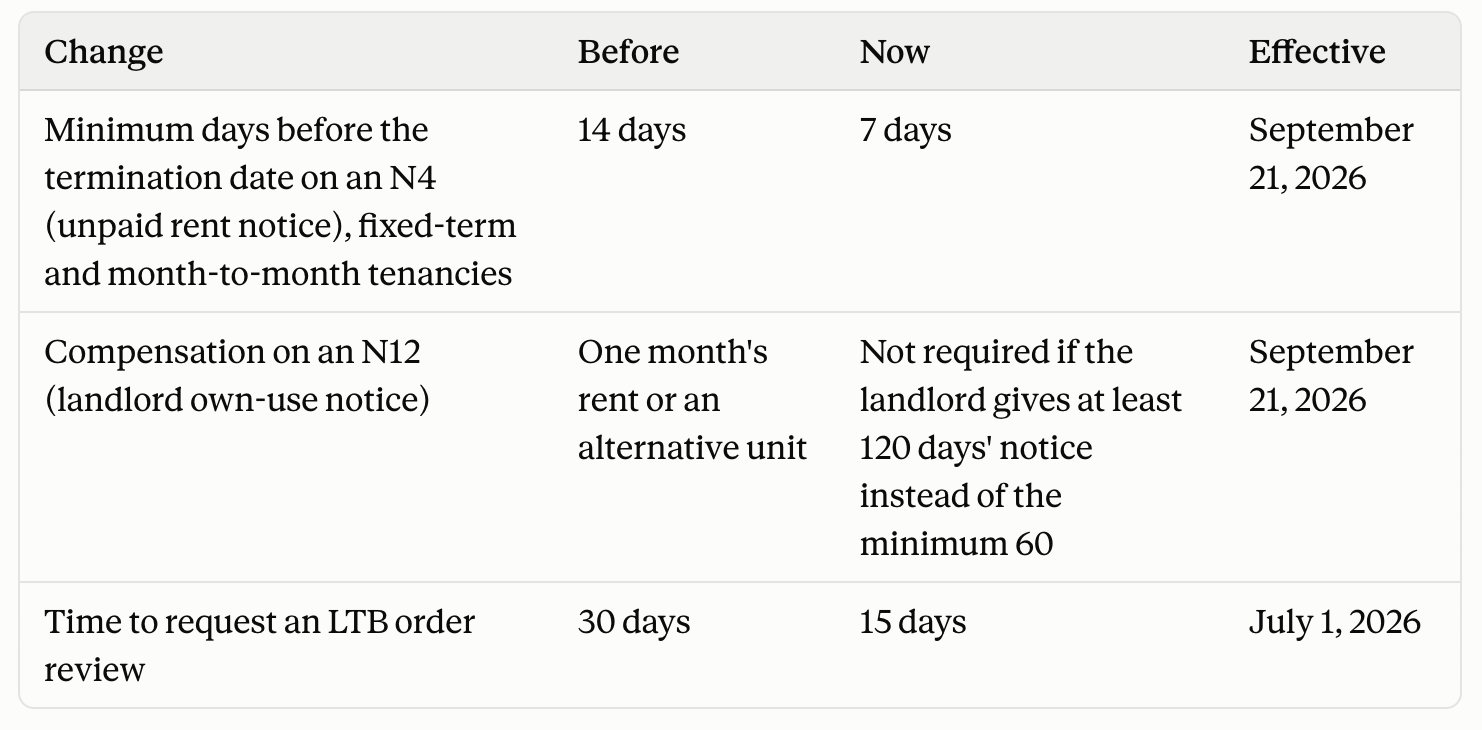
A first group took effect on July 1, 2026. The deadline to ask the LTB to review an order dropped from 30 days to 15, and tenants gained the right to install a window or portable air conditioner when certain conditions are met. Maximum fines for RTA offences also doubled, to $100,000 for individuals and $500,000 for corporations. Here is what changes on September 21.
Unpaid Rent: Shorter Notice and New Hearing Rules
An N4 is the notice a landlord gives when rent has not been paid. Until September 21, the termination date on an N4 for a fixed-term or month-to-month tenancy had to be at least 14 days after the notice was given. The minimum is now 7 days, as confirmed in the Ministry of Municipal Affairs and Housing's stakeholder memo. A landlord can apply to the LTB sooner if the rent remains unpaid, but an N4 is a notice, not an eviction order.
Ontario Regulation 241/26 also defines one form of persistent late payment, which is a ground a landlord can rely on when applying to end a tenancy. It includes a tenant failing to pay rent within 7 days of the due date on at least 3 occasions within any 6 month period. It does not apply where each failure was solely the result of the landlord applying a payment to another amount owing, such as arrears.
Tenants who want to raise their own issues at a hearing about unpaid rent, such as a maintenance problem, face new requirements. For applications filed on or after September 21, the tenant must, at least 7 days before the hearing, pay 50% of the arrears the landlord is claiming. They must also give the LTB and the landlord written notice of the issues and provide the evidence they will present.
Two further changes affect how eviction orders are challenged or delayed. The LTB will set aside an order made without the tenant present, where that order enforces a termination agreement, only if it is satisfied that doing so would not be unfair. The LTB may postpone an eviction if the landlord consents, or if a delay would not be unfair to the landlord or other tenants and there are compelling grounds.
Landlord Own-Use Evictions (N12)
An N12 is the notice a landlord gives when they, or a family member, need the unit to live in. The minimum notice is 60 days, and until September 21 the landlord also had to pay the tenant one month's rent or offer another acceptable unit. A landlord who gives at least 120 days' notice no longer has to do either.
Own-use evictions are also subject to a new presumption. If the person named in the notice does not move into the unit within 60 days, the eviction is presumed to have been made in bad faith unless the landlord proves otherwise. Bad faith means the landlord did not genuinely intend to use the unit as the notice said.
Renovations and Settlement Agreements
When a landlord ends a tenancy for repairs or renovations, a tenant who has told the landlord in writing that they want to move back can keep a right of first refusal to return. From September 21, the landlord must:
notify the tenant in writing of the estimated completion date
notify the tenant in writing of any change to that date
notify the tenant in writing of the final date the unit is ready for re-occupancy
give the tenant at least 60 days to reoccupy the unit after the renovations are completed
A tenant can apply to the LTB for a remedy for failure to afford a right of first refusal if the landlord does not provide these notifications or does not give the 60 days. The time to apply is now the later of two years from the date the tenant vacated, or six months after the renovations are completed.
Separately, where a landlord has filed an eviction application, any agreement the landlord and tenant reach outside the Board must use the Board-approved form.
I share updates like this because rental rules affect landlords, tenants and buyers of tenanted properties across Burlington, Oakville and Hamilton. This post is general information, not legal advice, and anyone with a specific notice or hearing should speak with a licensed paralegal or lawyer. If you own or are considering buying a rental property and want to talk through how these changes fit your situation, you're welcome to reach out.
Andrew Mclellan
Prep Work Makes the Rest Work™
Sources: Ontario Ministry of Municipal Affairs and Housing, stakeholder memo on changes coming into effect September 21, 2026 (April 2026). Tribunals Ontario, LTB Operational Update: Legislative Changes at the Landlord and Tenant Board (June 30, 2026). Ontario Regulation 516/06, section 8.1, added by O. Reg. 241/26. Advocacy Centre for Tenants Ontario, Bill 60 & Bill 97 Updated Factsheet (updated September 8, 2026).
